Get A Quote
Jul 29,2026
Packaging printers face a unique set of demands: short runs, frequent design changes, a growing variety of substrates, and pressure to switch to water-based inks. Traditional printing plates often struggle to keep up on all fronts—but modern flexible printing plates are engineered to address these challenges directly. Here are five common packaging production problems and how the right flexo plate helps solve them.
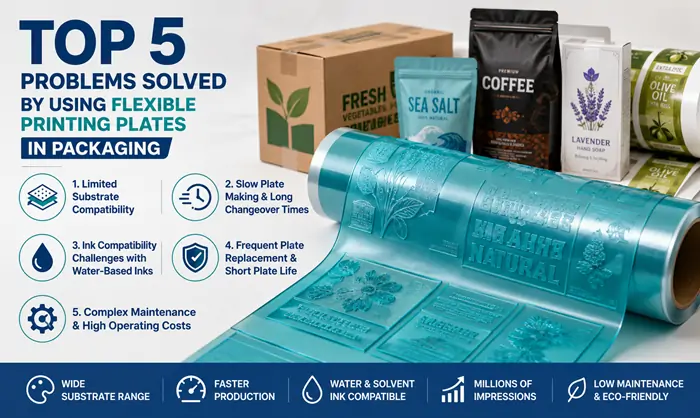
The problem: Packaging today spans an enormous range of materials—coated and uncoated paper, corrugated board, flexible plastic films, metallic foils, and even textured surfaces. A plate that performs well on smooth label stock may produce uneven ink transfer on rough kraft liner or corrugated board, leading to patchy solids and inconsistent color.
How flexible printing plates solve it: The STRONG product page highlights that flexible printing plates "can be printed on a variety of substrates including paper, plastic, metal, etc." This substrate versatility comes from the photopolymer material itself—it conforms to surface irregularities while maintaining consistent ink transfer. For corrugated applications specifically, models like the SF-L Digital Flexo Plates are described as "designed to meet all direct printing corrugated" requirements, while the SF-DGT Washable Flexographic Printing Plate is also positioned for "direct printing corrugated" work. The ability to use one plate type across multiple substrates simplifies inventory and reduces the need for substrate-specific plate stocks.
The problem: Packaging runs are getting shorter. Brand owners want regional variations, seasonal promotions, and rapid design updates. If plate making takes hours and changeover between jobs eats into press time, profitability suffers.
How flexible printing plates solve it: The STRONG product page notes that "the flushing speed can reach 180mm per minute, suitable for mass production." This processing speed applies to the plate making step—faster washout means plates go from imaged to press-ready more quickly. Digital flexo plates eliminate the film step entirely, further compressing the prepress workflow. For printers juggling multiple short-run jobs per shift, this speed directly translates to more sellable press hours. To see which digital plate types best match your production volume, you can review the available flexible printing plate options.
The problem: Regulatory pressure and brand sustainability commitments are pushing packaging printers toward water-based inks. But not all plates transfer water-based ink efficiently—some formulations cause swelling, dot gain drift, or premature plate wear.
How flexible printing plates solve it: The STRONG product page explicitly states that flexible printing plates "print with water-based or solvent-based inks, saving energy and supplies." Modern photopolymer formulations are engineered to resist the higher surface tension of water-based inks while maintaining clean ink release. This dual compatibility means a printer can transition from solvent to water-based inks without necessarily changing plate type—reducing the risk and cost of the switch.
The problem: In high-volume packaging production, plates that wear out after a few hundred thousand impressions create constant stoppages for plate changes. Each replacement means remaking plates, remounting on the press, and re-registering—costly in both materials and labor.
How flexible printing plates solve it: The STRONG product page notes that flexible printing plates "can be reused for millions of prints." This run length capability depends on the specific plate material and hardness—harder plates generally offer longer life on abrasive substrates like corrugated, while softer plates provide better ink transfer on smooth films. The SF-GL Hard Photopolymer Flexo Plate is specifically described as enabling "higher quality printing and productivity" with "excellent elasticity" for "fast and easy plate mounting." Matching the plate hardness to the substrate and run length requirement helps printers maximize impressions between plate changes.
The problem: Some printing plate systems require solvent-based washout, extended drying times, and careful chemical handling—adding cost, complexity, and environmental compliance burden to the plate making process.
How flexible printing plates solve it: The STRONG product page highlights "simple and convenient operation, low maintenance cost" as a key advantage. This is further supported by the availability of water-washable options like the SF-DGT Washable Flexographic Printing Plate, which eliminates solvent handling and disposal from the plate making workflow. Combined with digital imaging, water-washable plates create a cleaner, faster, and more environmentally manageable prepress process—particularly valuable for printers serving food and medicine flexible packaging markets, as referenced in the STRONG solutions section.
Q: Can one flexible printing plate type handle both paper and film substrates?
A: The STRONG product line includes plates with different hardness levels designed for different substrates. Softer plates generally perform better on rough or uneven surfaces like corrugated, while harder plates suit smooth films and paper. The SF-DGS Digital Versatile Flexo Plate is specifically described as softer and suitable for a broader range. The best choice depends on your specific substrate mix.
Q: What's the real difference between digital and analog flexible plates in packaging production?
A: Digital plates eliminate the film exposure step, which reduces image degradation and preserves finer highlight dots. This is particularly important for high-quality packaging graphics. Analog plates require film but may be more cost-effective for simpler work. The STRONG product range includes both types.
Q: How do I know if a water-washable plate is right for my operation?
A: Water-washable plates eliminate solvent handling and VOC emissions from the plate making area. They are well-suited for food packaging printers and operations looking to simplify environmental compliance. Processing speed and plate durability are comparable to solvent-based plates for most applications.
Q: What plate hardness should I choose for corrugated printing?
A: Corrugated printing typically benefits from softer to medium-hardness plates that can conform to the board surface without crushing the flutes. The STRONG SF-L and SF-DGT plates are specifically designed for direct corrugated printing.
Q: Can flexible printing plates be stored for long periods between uses?
A: Yes, with proper storage. Plates should be kept away from direct UV light, heat sources, and ozone-generating equipment. Clean plates thoroughly before storage, and store them flat or properly supported to prevent warping.
Flexible printing plates address the core pain points of modern packaging production: the need to print on diverse substrates, the demand for faster plate making and changeovers, the transition to water-based inks, the requirement for long plate life, and the push for simpler, more sustainable processes. The key is matching the right plate type—digital or analog, water-washable or solvent-based, soft or hard—to the specific demands of the packaging job.
For printers evaluating their current plate setup, the question is not whether flexible photopolymer plates can solve these problems, but which specific plate characteristics best match their substrate mix, press configuration, and run length patterns. If you'd like to discuss your specific packaging application and get a plate recommendation, contact STRONG to discuss your flexible printing requirements.
GET A QUOTE