
Get A Quote
Oct 30,2026
Food packaging compliance discussions usually focus on ink and substrate. The printing plate sits upstream, and the common assumption is that it never touches the final product—so it generates no compliance exposure. That assumption is wrong in specific scenarios. During flexographic printing, trace monomers and photoinitiators from photopolymer flexo plates can transfer to ink-contact surfaces, particularly on absorbent substrates like uncoated paperboard. For printers and brands sourcing flexographic printing plates for food-contact packaging, understanding this migration pathway—and knowing what documentation to request—is part of managing regulatory risk.
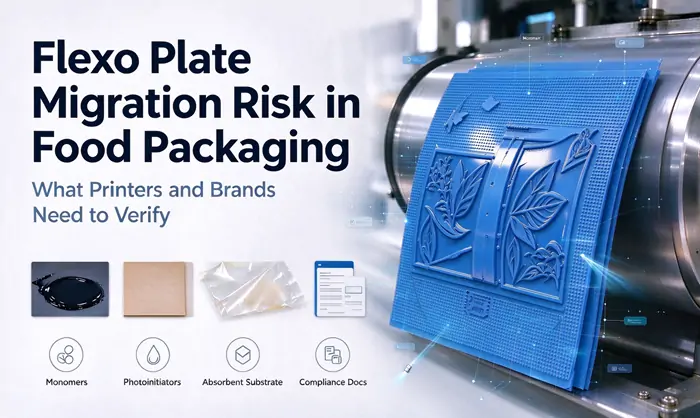
The migration risk from plates is indirect, not direct. The plate coating itself is not designed to transfer to the packaging. In fact, some plate manufacturers state explicitly that their plates do not come into direct contact with the exterior surfaces of packaging media during printing, and the plate coating is not transferred to the packaging during production.
But indirect pathways exist. During printing, trace monomers and photoinitiators from the photopolymer plate can transfer to ink-contact surfaces, especially when the substrate is absorbent. The risk is higher on uncoated paperboard and similar materials where surface absorption can draw residues into the fiber structure.
This is why plate compliance is not automatically covered by ink compliance. A low-migration ink system on a plate with undocumented chemistry still leaves a gap in the compliance chain.
The three major packaging markets regulate plate chemistry differently. Understanding the differences matters because a plate that satisfies one market’s documentation requirements may not satisfy another’s.
| Market | Relevant Framework | What It Means for Plate Chemistry | Documentation Typically Requested |
|---|---|---|---|
| EU | REACH SVHC list (>0.1% w/w); EU 10/2011 for food-contact | Plate monomers must be evaluated against SVHC thresholds; Declaration of Compliance required per batch | DoC per EU 10/2011 Annex IV; SDS per REACH |
| US | FDA 21 CFR 175.300 (indirect food additives) | Plate components must fall within sanctioned indirect additive categories | Letter of Guarantee or Supplier Declaration |
| China | GB 9685-2016 (approved additive list for food contact) | Plate additives must appear on the approved list; annual audit for licensed producers | GB/T compliance certificate; CIQ inspection records |
The EU framework is generally the most demanding, and documentation gaps are a common cause of shipment delays. A single missing REACH SVHC declaration on a photopolymer plate can hold up a large shipment at EU customs. Under EU 10/2011, a Declaration of Compliance must accompany every batch of food-contact packaging, and because plates are in the supply chain, the plate supplier must be able to trace chemistry back to the raw material supplier’s SDS.
For US brands, FDA 21 CFR 175.300 governs indirect food additives, and a Letter of Guarantee or Supplier Declaration is typically requested. China’s GB 9685-2016 requires plate additives to be on the approved list, with GB/T compliance certificates and CIQ inspection records for food-contact items.
Compliance is not a product feature that can be assumed from a nominal specification. It is a documentation and traceability capability. When evaluating a flexo plate supplier or flexo plate manufacturer for food packaging work, the conversation should move beyond durometer and caliper.
Request the compliance file for the specific plate grade. Not all plate chemistries are identical, and a general “food-safe” statement is not a substitute for a grade-specific declaration. Ask for the Declaration of Compliance (EU), Supplier Declaration (US), or GB/T certificate (China) that corresponds to the exact plate you will use.
Confirm traceability to raw material. The supplier should be able to trace plate chemistry back to the raw material supplier’s SDS. This is a requirement under EU 10/2011 and a useful indicator of overall quality management regardless of market.
Clarify the migration testing basis. Ask what migration testing, if any, has been conducted and under what conditions. Absence of a direct-contact statement does not automatically mean absence of indirect migration risk on absorbent substrates.
Verify quality management documentation. ISO 9001 and ISO 14001 are baseline indicators. For food-contact work, ask whether the supplier’s quality system includes change control for plate chemistry—because a formulation change can alter the compliance profile.
For a broader view of how plate specifications are verified in production, explore the quality assurance processes that support consistent plate performance.
Digital versus analog imaging does not eliminate migration risk. The risk comes from the photopolymer chemistry and the printing process, not from whether the image was created through a film negative or a digital mask.
That said, digital plate-making eliminates film and processing chemistry from the workflow, which simplifies the overall compliance picture at the prepress stage. Digital plates are not inherently “migration-free,” but they reduce the number of chemical inputs that need to be documented and controlled.
The practical point is that imaging method is secondary to plate chemistry documentation. A digital plate with incomplete compliance documentation is still a compliance risk. An analog plate with full traceability may be acceptable. The decision should be based on documentation, not on the label “digital.”
For plate options and compliance documentation for food packaging applications, review the flexographic printing plates available, or discuss your material and production requirements with the technical team.
The plate coating is not designed to transfer to packaging. However, trace monomers and photoinitiators from photopolymer plates can transfer to ink-contact surfaces during printing, particularly on absorbent substrates. The risk is indirect but real, and it is why plate chemistry documentation matters.
No. A general statement is not a substitute for grade-specific documentation. EU food-contact packaging typically requires a Declaration of Compliance per EU 10/2011; US jobs may require a Supplier Declaration referencing FDA 21 CFR 175.300; China requires GB 9685-2016 compliance and GB/T certificates.
No. Migration risk comes from photopolymer chemistry and the printing process, not from the imaging method. Digital plate-making reduces the number of chemical inputs in prepress, but plate chemistry documentation remains the deciding factor.
Request the grade-specific Declaration of Compliance (EU), Supplier Declaration (US), or GB/T certificate (China) for the exact plate you will use. Then confirm that the supplier can trace plate chemistry back to the raw material SDS.
Absorbent substrates like uncoated paperboard can draw residues into the fiber structure, increasing the potential for trace plate components to reach ink-contact surfaces. Migration behavior should be tested on the actual substrate, not assumed from a generic statement.
No. Plate chemistry and ink chemistry are separate parts of the compliance chain. A low-migration ink on a plate with undocumented chemistry still leaves a gap. Both the ink and the plate should have appropriate documentation for the target market.
Plate migration risk in food packaging is an indirect but documented concern. Trace monomers and photoinitiators from photopolymer plates can transfer to ink-contact surfaces, particularly on absorbent substrates, and the EU, US, and China regulate plate chemistry through different frameworks. The practical response is not to avoid flexo plates, but to treat compliance as a documentation and traceability requirement.
Request grade-specific declarations, confirm raw-material traceability, ask about migration testing, and verify change control. Whether you source from a manufacturer or a supplier, the ability to produce compliant documentation for the exact plate grade is the relevant capability—not a general “food-safe” label. For a starting point on plate options for food packaging applications, explore the available configurations or discuss your specific market and substrate requirements with the technical team.
Disclaimer: The information in this article is provided for general guidance only. Food-contact compliance requirements vary by market, application, substrate, and end-use conditions. Regulatory frameworks are subject to change. Actual compliance should be verified with qualified regulatory professionals and confirmed with plate and ink suppliers based on the specific application and target market.
GET A QUOTE