Get A Quote
Oct 28,2026
Corrugated board is often discussed as a single substrate, but the printing surface—the liner—varies widely. Uncoated kraft liner is rough and absorbent. Recycled liner contains varying fiber quality that changes surface texture from batch to batch. Coated liner is smooth and holds fine detail. Each surface interacts differently with the printing plate, and a plate that performs well on one liner may produce washboarding, dot gain, or weak solids on another. This article explains how liner type should influence plate hardness, calliper, and imaging choice, and what to verify when sourcing from a plate manufacturer.
To compare plate options designed for different liner surfaces, review the flexographic printing plates available for corrugated applications.
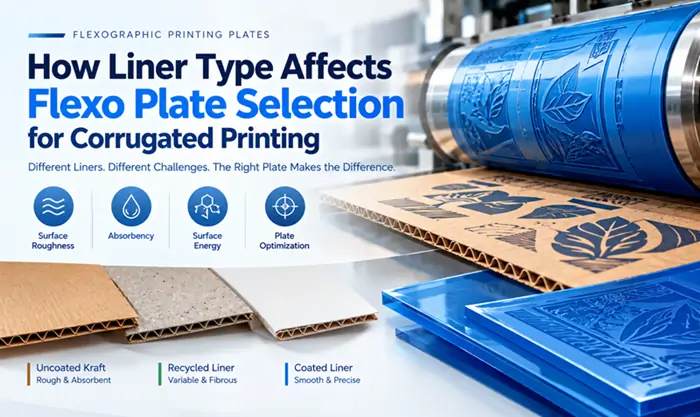
Board grade—single-wall, double-wall, flute type—sets the structural context. But the liner is what the plate actually touches. Two boards with the same flute profile can print very differently if one uses uncoated kraft and the other uses coated white liner.
The liner affects three things the plate must respond to:
A flexographic plate for corrugated printing is selected to balance these three factors against the liner in use, not just the board structure.
Uncoated kraft is the most common liner in shipping and industrial packaging. Its surface is rough, fibrous, and absorbent. The priority is contact—getting ink into the flute valleys without crushing the board.
Recommended plate direction: A soft flexo plate in the Shore A 25–35 range conforms to the rough surface at low impression pressure. A 6.35 mm flexo plate provides the compressible cushion needed to bridge liner roughness without excessive pressure. Relief depth around 2.0–3.0 mm supports clean ink separation.
What to watch: Even a soft plate can produce weak solids if the liner absorbs ink too quickly. Ink viscosity and anilox volume often need adjustment alongside plate selection. Washboarding on uncoated kraft usually points to insufficient plate conformity or too much impression pressure.
Recycled liner is made from recovered fiber. Its surface texture varies more than virgin kraft—some batches are rougher, some contain visible fiber clusters, and absorbency can shift. This variability makes corrugated flexo plates harder to specify because the substrate itself is not consistent.
Recommended plate direction: A soft plate remains appropriate, but consistency of plate thickness becomes more important. If plate calliper varies across the sheet, the press operator cannot compensate for liner variation with a single pressure setting. Thickness tolerance should be confirmed before ordering.
What to watch: Recycled liner is where plate consistency shows up. A plate that is nominally 6.35 mm but varies in calliper will amplify the liner's own inconsistency. This is one reason to verify tolerances with a flexo plate supplier rather than relying on nominal specifications alone.
Coated liner—often white-top or clay-coated—is used for retail packaging where graphics matter. The surface is smooth and less absorbent, which allows finer screens and sharper detail. But it also changes the plate trade-off.
Recommended plate direction: A slightly harder plate (Shore A 35–45) can hold finer dots on coated liner without excessive dot gain. Thinner plates with compressible backing are sometimes used when fine detail is the priority. Digital flexo plates with flat top dots are particularly valuable here because they maintain dot size across a wider pressure window, reducing dot gain variation on smooth surfaces.
What to watch: On coated liner, the risk shifts from washboarding to dot gain and ink starvation. A plate that is too soft may over-compress and close highlights. Photopolymer flexo plates formulated for sharper dot structure are often preferred when the liner is smooth, and the graphics are demanding.
| Liner Type | Surface Character | Plate Hardness | Caliper Direction | Imaging Preference |
|---|---|---|---|---|
| Uncoated kraft | Rough, absorbent | Soft (25–35 Shore A) | 6.35 mm standard | Analog or digital |
| Recycled | Variable, fibrous | Soft to medium (30–40 Shore A) | 6.35 mm, tight tolerance | Digital preferred for consistency |
| Coated white-top | Smooth, less absorbent | Medium (35–45 Shore A) | 6.35 mm or thinner with backing | Digital with flat top dots |
| Heavy double-wall kraft | Rough, thick | Soft, high caliper | 7.00 mm where equipment allows | Analog or digital |
This matrix is a starting point, not a rule. The interaction between liner, ink, anilox, and press conditions means the final selection should be confirmed on the actual substrate.
Because liner type changes plate behavior, specification sheets alone are insufficient. Verification should cover both the plate and the supplier.
Plate-level checks:
Supplier-level checks:
For corrugated applications where liner roughness is the primary challenge, the SF-DGS Digital Versatile Flexo Plate is designed with a softer, less rigid photopolymer that supports conformity on rough surfaces while maintaining highlight dot structure.
Yes. Uncoated kraft needs a softer plate for conformity. Coated liner can use a slightly harder plate for finer detail. Recycled liner places more emphasis on plate thickness consistency because the substrate itself varies.
Shore A 25–35 is the common range for uncoated kraft. Plates around Shore A 29 are often used for washboard reduction on C and B flutes. The exact hardness should be confirmed with a sample run on your liner.
6.35 mm is the most common practical default, but it is not universal. Heavy double-wall board may need 7.00 mm, and some fine-detail jobs on coated liner may use thinner plates with compressible backing.
Digital plates with flat top dots help maintain dot size across a wider pressure range, which reduces dot gain variation on smooth coated surfaces. They are particularly useful when fine detail and highlight control matter.
Request a sample plate and run it on the actual liner and flute combination you use, under production press settings. Evaluate washboarding, solid density, and highlight retention. Do not rely on a generic board sample.
Ask for thickness tolerance data, durometer range, and whether the supplier can recommend specifications based on liner type. A supplier that understands liner differences is more useful than one that only quotes nominal plate specifications.
Liner type is an under-discussed variable in corrugated plate selection. Uncoated kraft, recycled, and coated liners place different demands on plate hardness, caliper, and imaging method. A soft plate with a 6.35 mm caliper suits rough kraft; a slightly harder digital plate may hold detail better on coated liner; recycled liner puts a premium on plate thickness consistency.
The practical takeaway is to specify plates against the liner, not just the board grade, and to verify performance on the actual substrate. Whether you source from a manufacturer or a supplier, ask for tolerance data and technical support that addresses liner-specific behavior. For a starting point on plate configurations for different liner surfaces, explore the available options or discuss your material and production requirements with the technical team.
Disclaimer: The information in this article is provided for general guidance only. Plate selection depends on liner type, board grade, press conditions, ink chemistry, anilox specification, and plate-making parameters. Actual performance should be verified through testing on production equipment. Buyers should confirm specifications with their supplier before placing an order.
GET A QUOTE