Get A Quote
Aug 06,2026
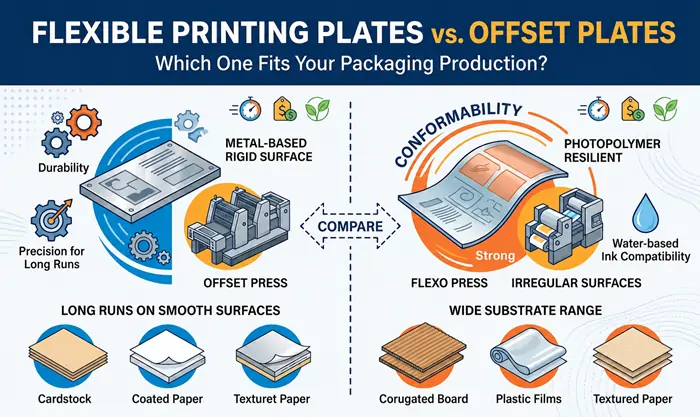
Packaging printers face a fundamental choice when selecting printing plates: offset plates or flexible printing plates? The answer depends on your substrates, run lengths, design complexity, and press configuration. Offset plates—typically aluminum-based—offer durability and precision for long runs on smooth surfaces. Photopolymer plates, by contrast, conform to irregular surfaces and handle a wider range of substrates. This article compares the two plate types across key decision factors and provides a practical framework for choosing the right option for your packaging production.
To explore the available options, review the flexible printing plate configurations designed for different packaging applications.
Offset plates (also called CTP plates or aluminum offset plates) are typically made from aluminum with a photosensitive coating. They are mounted on plate cylinders in offset presses and provide a rigid, non-compressible printing surface. Offset plates are the traditional choice for commercial printing on flat, smooth substrates like coated paper and cardstock.
Photopolymer plates are made from soft, resilient polymers that are photosensitive and can be processed into relief printing plates. These plates flex and compress against the substrate during printing, making them suitable for flexographic presses. STRONG's flexographic plate offerings use advanced manufacturing processes to ensure precision and stability during plate making, with precision imaging technology that makes printed images clearer and more accurate. They can be reused for millions of prints, with flushing speed reaching 180mm per minute for mass production.
| Factor | Offset Plates (CTP/Aluminum) | Photopolymer Plates |
|---|---|---|
| Material | Aluminum with photosensitive coating | Photopolymer |
| Substrate compatibility | Smooth, flat surfaces (coated paper, cardstock) | Wide range: paper, plastic, metal, corrugated board, films, foils |
| Surface irregularity handling | Poor—requires perfectly flat surfaces | Excellent—conforms to surface irregularities |
| Ink compatibility | Primarily oil-based and UV inks | Water-based or solvent-based inks |
| Press type | Offset presses | Flexographic presses |
| Plate making | Film-based or CTP | Digital or analog photopolymer processing |
| Durability | Very high—millions of impressions | High—millions of impressions with proper care |
| Cost per plate | Moderate to high | Lower to moderate |
| Changeover speed | Slower | Faster—washout speed up to 180mm/min |
Offset plates remain the better choice in specific scenarios:
1. Long runs on smooth substrates. If you print primarily on coated paper, cardstock, or other smooth, flat surfaces—and your runs exceed 500,000 impressions—aluminum offset plates offer superior durability and consistent dot reproduction.
2. High-precision color work. For jobs requiring extremely fine screens (above 200 lpi) and tight registration tolerance, CTP plates provide the dimensional stability needed for consistent multi-color alignment.
3. Existing offset infrastructure. If your pressroom is already equipped with offset presses and CTP devices, switching to flexo would require significant capital investment.
4. UV ink systems. Offset plates are well-established for UV ink applications, particularly in commercial printing and certain packaging segments.
Photopolymer plates are increasingly the preferred choice for modern packaging production. Here are the scenarios where they excel:
Packaging today spans an enormous range of materials—coated and uncoated paper, corrugated board, flexible plastic films, metallic foils, and textured surfaces. Photopolymer plates can be printed on all these substrates. The material conforms to surface irregularities while maintaining consistent ink transfer. For corrugated applications specifically, models like the SF-L Digital Flexo Plates are designed to meet all direct printing corrugated requirements.
If your operation handles multiple substrate types, these plates simplify inventory by eliminating the need for substrate-specific plate stocks.
Packaging runs are getting shorter. Brand owners want regional variations, seasonal promotions, and rapid design updates. Photopolymer plates offer faster plate making—the flushing speed can reach 180mm per minute. Digital versions eliminate the film step entirely, further compressing the prepress workflow.
For printers juggling multiple short-run jobs per shift, this speed translates directly to more sellable press hours.
Regulatory pressure and brand sustainability commitments are pushing packaging printers toward water-based inks. Photopolymer plates print with water-based or solvent-based inks, saving energy and supplies. Modern formulations are engineered to resist the higher surface tension of water-based inks while maintaining clean ink release.
If you are transitioning to water-based inks, these plates offer a practical path forward without compromising print quality.
Offset plates cannot effectively print on corrugated board or other uneven surfaces—the rigid aluminum plate cannot conform to the substrate's topography, resulting in poor ink transfer and patchy solids. Photopolymer plates, by contrast, compress against the substrate to deliver consistent ink coverage across the entire print area. For corrugated packaging—a growing segment in e-commerce and retail—these plates are essentially the only viable option.
For a broader view of how flexo plates integrate into packaging workflows, explore the packaging printing solutions available for different applications.
Within the photopolymer plate category, buyers face another choice: digital or analog?
| Factor | Analog Flexo Plates | Digital Flexo Plates |
|---|---|---|
| Plate-making process | Film-based (requires film output) | Direct digital imaging (no film) |
| Registration accuracy | Good—but film shrinkage can introduce errors | Excellent—digital eliminates film variability |
| Highlight dot reproduction | Limited—fine dots may wash out | Superior—better highlight retention |
| Prepress workflow | Slower—multiple film steps | Faster—direct-to-plate |
| Cost | Lower upfront cost | Higher upfront, better long-term value |
STRONG offers both digital and analog options, including SF-L Digital Flexo Plates for corrugated, SF-GT Analog Photopolymer Sheet Plates, and SF-DGT Washable Flexographic Printing Plates. Digital plates are increasingly the standard for packaging work requiring fine screens and fast turnaround.
Use this checklist to evaluate your specific requirements:
• What substrates do you print on most frequently? Smooth paper/cardstock → offset plates may work. Corrugated, films, foils, or mixed substrates → photopolymer plates are strongly recommended.
• What is your typical run length? Above 500,000 impressions on smooth substrates → offset plates. Short to medium runs, or long runs on varied substrates → photopolymer plates.
• Are you using or planning to use water-based inks? Yes → photopolymer plates are better suited.
• How frequently do you change over between jobs? Multiple changeovers per shift → photopolymer plates offer faster processing.
• What is your press type? Offset press → offset plates. Flexo press → photopolymer plates.
• Do you print corrugated board? Yes → photopolymer plates are required.
• What is your priority: plate cost or total production cost? Lower plate cost → analog flexo or offset plates may appear cheaper. Lower total cost per job → digital flexo plates often win due to faster setup and less waste.
For personalized guidance based on your specific substrates and production volume, discuss your material and production requirements with the technical team.
Misconception 1: "Photopolymer plates are less durable than offset plates."
Reality: With proper care, these plates can be reused for millions of prints. Durability depends more on substrate abrasiveness, ink type, and maintenance practices than on plate type alone.
Misconception 2: "Photopolymer plates can't handle fine screens."
Reality: Modern digital flexo plates achieve high-resolution printing effects with excellent highlight dot retention. Digital plates, in particular, outperform analog plates in fine screen reproduction.
Misconception 3: "Offset plates are always cheaper."
Reality: While offset plates may have lower per-plate cost, photopolymer plates often deliver lower total cost per job when factoring in faster setup, less waste, and substrate versatility.
The main difference is material and compressibility. Offset plates are made of aluminum and provide a rigid, non-compressible printing surface for smooth substrates. Photopolymer plates are made of soft polymer and compress against the substrate, making them suitable for corrugated board, films, and other irregular surfaces.
Yes. Photopolymer plates can be printed on a variety of substrates including paper, plastic, metal, and more. They are commonly used for paper-based packaging including folding cartons, labels, and corrugated boxes.
Digital flexo plates eliminate the film step entirely, reducing errors from film shrinkage and providing better highlight dot retention. They are generally preferred for packaging work requiring fine screens and fast turnaround. Analog plates remain a cost-effective option for simpler jobs.
With proper care and maintenance, photopolymer plates can be reused for millions of prints. Actual lifespan depends on substrate abrasiveness, ink type, press conditions, and cleaning procedures.
Photopolymer plates are suitable for a wide range of substrates including paper, plastic, metal, corrugated board, flexible films, and metallic foils.
Choose photopolymer plates when you print on corrugated board or irregular surfaces, use multiple substrate types, run short to medium lengths with frequent changeovers, or use water-based inks.
The choice between offset plates and photopolymer plates is not about which is "better" in absolute terms—it is about which fits your specific production requirements. Offset plates remain a solid choice for long runs on smooth substrates in offset environments. Photopolymer plates are the clear winner for corrugated packaging, mixed substrates, short runs, water-based inks, and any application where substrate irregularity is a factor.
For most modern packaging operations—particularly those handling corrugated board, flexible films, or frequent design changes—photopolymer plates offer a practical combination of versatility, speed, and print quality. Digital flexo plates, in particular, provide the precision and workflow efficiency that today's packaging market demands.
If you are evaluating plate options for a new packaging project or considering a transition to flexo, review the available flexible printing plate configurations and discuss your specific substrate and production requirements with the supplier.
For additional support in achieving consistent print quality, explore the service and support options available.
GET A QUOTE