Get A Quote
Oct 22,2026
Corrugated board is not a flat surface. The flutes create peaks and valleys, and the liner varies in roughness and absorbency. Plate thickness is the first physical buffer between the press and that uneven surface. A plate that is too thin cannot absorb the height differences without excessive impression pressure; a plate that is too thick may sacrifice fine detail or create mounting complications. In corrugated post-print, 6.35 mm (0.250") is the most widely referenced caliper, but it is not the only correct answer. This guide explains how thickness interacts with relief depth and hardness, why 6.35 mm became common, and how to decide whether a thicker or thinner plate fits a specific job.
To explore the available options, review the flexible printing plate configurations designed for corrugated and other packaging substrates.
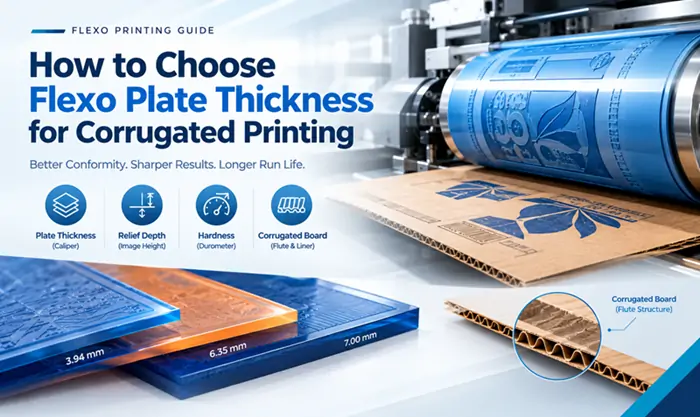
In flexographic printing, the plate sits on a cylinder and transfers ink to the substrate under light pressure. On smooth paper or film, the plate can be relatively thin because the substrate surface is consistent. Corrugated board changes that equation.
The flute structure means the plate must bridge height differences across the board. If the plate is too thin, the press must apply more pressure to force contact with the flute valleys. That extra pressure compresses the plate, distorts dots, and can crush the corrugated structure itself. Thicker plates provide more compressible material between the cylinder and the printing surface, allowing the plate to conform to the board with less impression pressure.
This is why corrugated post-print has historically favored thicker calipers than narrow-web or label printing. The plate is not just carrying the image—it is acting as a mechanical cushion.
Among corrugated plate calipers, 6.35 mm occupies a practical middle ground. It is thick enough to provide meaningful conformity on standard C-flute and B-flute board, but not so thick that it becomes difficult to mount or impossible to hold fine detail.
Industry product data shows 6.35 mm plates are commonly specified for corrugated post-print. For example, 6.35 mm photopolymer plates are listed for post-print corrugated card, described as offering excellent ink transfer, the ability to hold fine detail and screens, and long run life with minimum press pressure. Technical data sheets for soft corrugated plates often list 6.35 mm as the thickest standard caliper, paired with Shore A hardness in the high 20s to mid-30s and relief depths around 2.0–3.0 mm.
The pattern is consistent: 6.35 mm is thick enough to cushion the flute, but thin enough to remain compatible with standard mounting systems and digital plate-making workflows.
Plate thickness cannot be selected in isolation. It interacts with two other specifications: relief depth and hardness.
Relief depth is the distance between the plate floor and the top of the image. Thicker plates can accommodate deeper relief. On a 6.35 mm corrugated plate, typical relief depth ranges from about 2.0 mm to 3.0 mm. A shallower relief on a thick plate may not provide enough separation for ink transfer; a deeper relief may weaken fine dot anchoring.
Hardness determines how much the plate compresses under pressure. Corrugated plates are generally softer—often in the Shore A 25–35 range—because a softer plate conforms more readily to the board surface. A thick, soft plate combination provides the cushioning needed for rough board, but it also places limits on how fine a screen ruling can be held.
The practical rule is: thicker caliper supports softer durometer and deeper relief, which together improve conformity but reduce the ability to hold very fine detail. The selection decision is a trade-off, not a single-number answer.
| Scenario | 6.35 mm fit | Alternative to consider |
|---|---|---|
| Standard C-flute or B-flute post-print, mixed solids and halftones | Strong fit | — |
| Rough, uncoated kraft liner; washboard effect is a concern | Good fit with a soft plate | Softer 6.35 mm grade; verify relief |
| Fine-line, high-screen halftone on smoother liner | May limit fine detail | Thinner caliper (e.g., 3.94 mm) with a compressible backing |
| Heavy-duty or double-wall board | Often preferred | Thicker 7.00 mm where equipment allows |
| Short-run, simple graphics | Workable, but not always necessary | 3.94 mm may reduce plate cost |
The table reflects a practical tension. Thicker plates like 6.35 mm provide forgiveness on rough board, but they are not automatically the best choice for every corrugated job. Some operations use thinner plates (3.94 mm or below) combined with compressible backing to achieve better fine-detail reproduction while still managing board irregularity. The right answer depends on board grade, graphic complexity, and press setup.
Two plates with the same nominal caliper can behave differently if thickness tolerance is loose. On corrugated, thickness variation translates directly into impression variation: a plate that is thick in one area and thin in another will print unevenly, and the press operator may compensate with pressure that is wrong for part of the sheet.
Photopolymer plate specifications often state a raw material thickness tolerance in the range of ±30 μm (about ±0.03 mm) or comparable. For corrugated work, where the plate is already thick and soft, this tolerance is generally acceptable—but it should be verified, not assumed. A supplier that controls caliper consistency reduces the need for press-side adjustment and helps maintain registration across long runs.
For a broader view of how plate specifications are verified in production, explore the quality assurance processes that support consistent plate performance.
Use this checklist before specifying a plate caliper:
For personalized guidance based on your specific board grades and press configuration, discuss your material and production requirements with the technical team.
6.35 mm (0.250") provides enough compressible material to conform to the flute structure with lower impression pressure, while remaining compatible with standard mounting systems and plate-making workflows. It is widely specified for corrugated post-print because it balances conformity, durability, and detail reproduction.
No. Thicker plates improve conformity on rough board, but they can limit fine detail reproduction and may require deeper relief. Thinner plates combined with compressible backing can hold finer detail on smoother liners. The right choice depends on board grade, graphics, and press setup.
Thicker plates can accommodate deeper relief. On a 6.35 mm corrugated plate, relief depth is typically around 2.0–3.0 mm. Relief that is too shallow may not provide adequate ink separation; relief that is too deep can weaken dot anchoring.
Many photopolymer plate specifications state raw material thickness tolerance in the range of ±30 μm (about ±0.03 mm) or comparable. For corrugated work, this tolerance is generally acceptable, but it should be confirmed with the supplier and verified against registration requirements.
Yes, in some cases. Thinner plates (3.94 mm or below) with compressible backing are used on corrugated when fine detail is the priority and the board surface is relatively consistent. They are not a universal substitute for thicker plates on rough or heavy board.
Hardness and thickness are separate specifications, but they are selected together. Thicker corrugated plates are often paired with softer durometer (Shore A 25–35) to maximize conformity. A thick hard plate provides cushioning but may not conform as well to rough liner surfaces.
Flexo plate thickness for corrugated printing is a trade-off between conformity and detail. 6.35 mm is a practical default for standard C/B-flute post-print because it provides cushioning without making mounting or plate-making impractical. But it is not a universal answer. Thicker plates suit heavy or very rough board; thinner plates with compressible backing may hold finer detail on smoother liners.
The decision should be made alongside relief depth and hardness, not in isolation. Thickness tolerance also matters: a nominally correct caliper with loose tolerance can still produce uneven impression. Verify the specification, match it to the board and graphics, and confirm compatibility with the mounting system before the job goes to press.
If you are evaluating plate options for a corrugated application, review the available flexible printing plate configurations and discuss your specific board grades and press setup with the supplier.
Disclaimer: The information in this article is provided for general guidance only. Plate thickness selection depends on board grade, press configuration, mounting system, ink type, and graphic requirements. Actual performance should be verified through testing on production equipment. Buyers should confirm specifications with their supplier before placing an order.
GET A QUOTE