
Get A Quote
Sep 10,2026
Flexo plate hardness—measured on the Shore A scale—is one of the most important specifications for print quality. A plate that is too soft compresses too much under pressure, causing dot gain and slur. A plate that is too hard cannot conform to rough surfaces, leading to poor ink transfer and patchy solids. The right hardness depends on the substrate: softer plates for corrugated board, medium plates for paper and cartons, and harder plates for films and foils. This guide explains how to match plate hardness to your substrate and what to check before placing an order.
To explore the available options, review the flexible printing plate configurations designed for different substrates and applications.
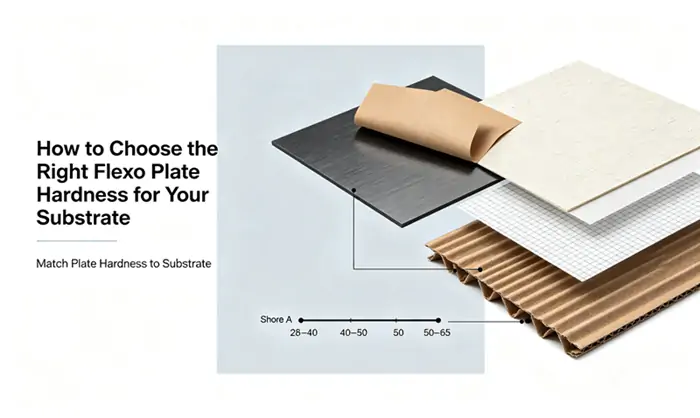
Shore A hardness is the standard scale for measuring the elasticity of flexographic printing plates. The scale ranges from 0 (very soft) to 100 (very hard). For flexo plates, the useful range is typically between 20 and 80 Shore A. The measurement is taken per ASTM D2240 using a Type A durometer, and for flexo plates, it is normally measured at 0.250-inch thickness without polyester backing.
The softer the plate, the better it conforms to uneven surfaces. The harder the plate, the better it holds fine dot structure. The challenge is finding the balance that matches the substrate.
Here is a practical reference for matching plate hardness to common substrates:
| Substrate | Recommended Shore A | Plate Behavior | Why |
|---|---|---|---|
| Corrugated board (rough) | 29–40 | Soft—conforms to flute peaks and valleys | Rough surface needs a soft plate to maintain full contact |
| Corrugated board (high-speed) | 70–80 | Hard—resists abrasion and wear | High-speed carton production requires durability |
| Paper / folding cartons | 40–50 | Medium—balance of conformability and dot stability | Paper is smoother than corrugated but not perfectly flat |
| Labels / coated stock | 50–60 | Medium-hard—sharper dots | Smooth substrates allow harder plates with less dot gain |
| Film / foil / flexible packaging | 55–65 | Hard—precise dot reproduction | Very smooth surfaces demand the sharpest dot structure |
STRONG's flexible printing plate range includes models designed for different hardness requirements. The SF-DGS Digital Versatile Flexo Plate is a softer, less rigid photopolymer ideal for corrugated board surfaces, reducing washboard effects. For rough corrugated paper and high-speed carton production, the SF-GT Analog Photopolymer Sheet Plate uses a high-hardness resin system with Shore A hardness reaching 70 to 80.
Too soft: The plate deforms excessively under impression pressure. Fine lines and text slur together. Dot gain increases, closing up highlights. The plate wears faster on abrasive substrates because it compresses more.
Too hard: The plate cannot conform to uneven surfaces. On corrugated board, hard plates produce patchy solids and missing dots where the plate fails to contact the valleys. On smoother substrates, hard plates can cause ink starvation if impression settings are not adjusted correctly.
| Problem | Likely Cause | Solution |
|---|---|---|
| Slurred text, excessive dot gain | Plate too soft for the substrate | Increase Shore A hardness; reduce impression pressure |
| Patchy solids, missing dots on rough board | Plate too hard to conform | Switch to softer plate; verify mounting tape |
| Fine details closing up | Plate too soft or over-pressured | Reduce pressure; consider harder plate |
| Plate wears out prematurely | Plate too soft for abrasive substrate | Use higher-hardness plate for corrugated |
Don't assume the plate is correct just because the specification sheet says so. Verify before every job:
For personalized guidance on hardness selection for your specific substrate and press conditions, discuss your material and production requirements with the technical team.
For detailed specifications and model comparisons, visit the flexible printing plate product page.
The most commonly used flexo plate hardness range is 50–65 Shore A. This range covers a wide range of substrates, from paper and cartons to labels and some film applications. For corrugated board, softer plates (29–40 Shore A) are standard. For film and foil, harder plates (55–65 Shore A) are preferred.
A plate that is too soft compresses too much under impression pressure. Fine lines and text may slur together. Dot gain increases, closing up highlight details. The plate may also wear faster on abrasive substrates because it deforms more under pressure.
A plate that is too hard cannot conform to uneven surfaces. On corrugated board, this results in patchy solids and missing dots where the plate fails to contact the valleys. On smoother substrates, a hard plate may cause ink starvation if impression settings are not adjusted correctly.
Flexo plate hardness is measured using a Type A durometer per ASTM D2240. The measurement is taken at 0.250-inch thickness without polyester backing. Most suppliers specify an acceptance tolerance of ±3 Shore A units.
No. Plate hardness is determined by the photopolymer formulation and the plate-making process. Once the plate is manufactured, its hardness cannot be changed. This is why selecting the right hardness before ordering is critical.
Yes. The mounting tape hardness interacts with plate hardness. A soft plate on hard tape behaves differently than the same plate on soft tape. For corrugated board, compressible foam tapes are often used with softer plates to improve conformity. For smooth substrates, harder tapes may be used with harder plates. Always verify the plate-and-tape combination with your supplier.
Flexo plate hardness is not a "one size fits all" specification. The right hardness depends on your substrate, screen ruling, impression pressure, ink system, and run length. Softer plates conform to rough surfaces like corrugated board. Harder plates hold fine dots on smooth substrates like film and foil. Medium plates balance both for paper and cartons.
Selecting the wrong hardness leads to slurred text, patchy solids, excessive dot gain, and premature plate wear. Verify hardness with a durometer before mounting, and confirm the plate-and-tape combination with your supplier.
If you are evaluating plate options for a new application, review the available flexible printing plate configurations and discuss your specific substrate and production requirements with the supplier.
Disclaimer: The information in this article is provided for general guidance only. Plate hardness, exposure settings, and press conditions vary by substrate, equipment, and production environment. Actual performance depends on operating conditions and should be verified through testing. Buyers should confirm specifications with their supplier before placing an order.
GET A QUOTE