Get A Quote
Sep 01,2026
Computer-to-plate technology has transformed the printing industry, replacing film-based workflows with direct digital imaging. Within CTP, two main plate types dominate: thermal CTP and UV-CTP. UV-CTP plates use violet laser imaging at a wavelength of around 405nm, offering fast exposure speeds and high sensitivity. They are particularly well-suited for commercial printing, packaging, and newspaper production. This article explains how they work, compares them with thermal CTP, and outlines when they are the right choice for your printing operation.
To explore the available options, review the available UV-CTP plate configurations designed for different printing applications.
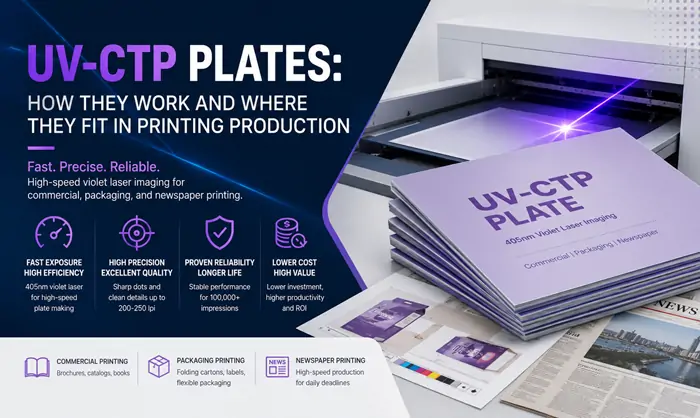
UV-CTP plates are photopolymer plates that are imaged using a violet laser diode with a wavelength of approximately 405nm. The laser exposes the plate, creating chemical changes that form the image. The plate is then developed in a separate processor using chemicals that remove the unexposed areas, leaving the image.
The "UV" in UV-CTP refers to the exposure wavelength, not the printing process. These plates are primarily used in conventional printing environments—they work with standard inks, fountain solutions, and press conditions.
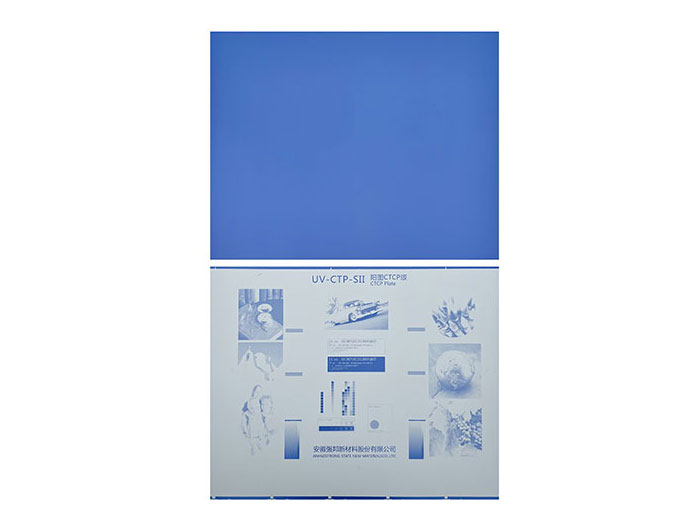
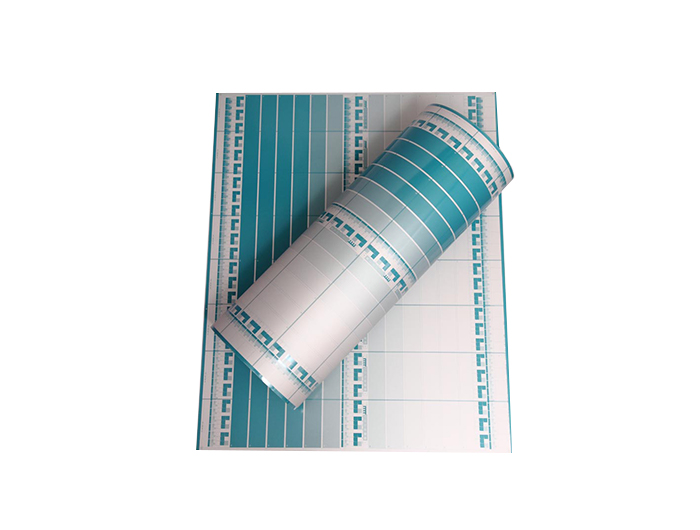
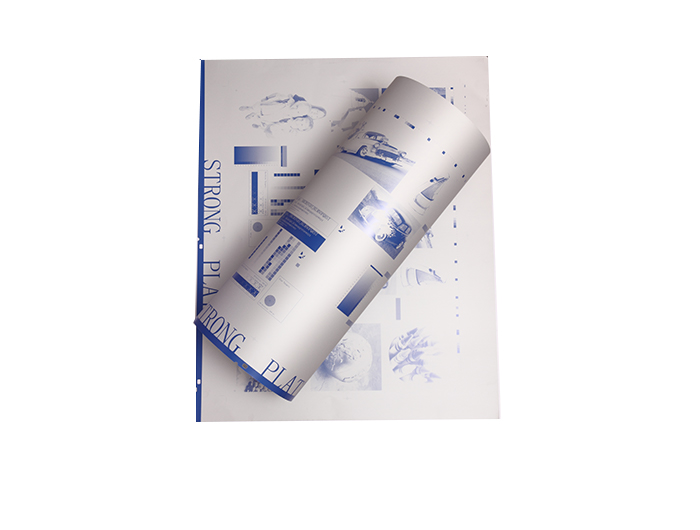
STRONG's UV-CTP offerings are photopolymer plates with high sensitivity, exposed by a violet laser diode at 405nm. They are suitable for commercial printing, packaging printing, and newspaper printing.
The plate-making process follows these steps:
Step 1: Digital File Preparation. The digital artwork file is prepared and sent to the CTP system. No film is involved—the plate is imaged directly from the digital file.
Step 2: Laser Exposure. The violet laser diode (405nm) scans the plate, exposing the photopolymer coating. The exposed areas undergo a chemical change that makes them soluble or insoluble in the developer, depending on the plate type. These plates offer fast exposure speed for high production efficiency.
Step 3: Development. The exposed plate is processed in a developer solution. The image areas are fixed on the plate, while the non-image areas are washed away.
Step 4: Finishing. The plate may undergo post-processing steps such as gumming to protect the surface and prepare it for press mounting.
One of the most common questions printers ask is: UV-CTP or thermal CTP? Here's how they compare:
| Factor | UV-CTP | Thermal CTP |
|---|---|---|
| Imaging wavelength | 405nm (violet laser) | 830nm (infrared laser) |
| Exposure speed | Faster | Slower |
| Sensitivity | High | Lower |
| Plate stability | Good—but requires yellow light handling | Excellent—daylight stable |
| Dot shape | Good | Superior—more precise dot structure |
| Plate longevity | 100,000-150,000 impressions | 200,000+ impressions |
| Best suited for | Commercial, packaging, newspaper | Commercial, packaging, UV ink printing |
| Equipment cost | Lower | Higher |
Speed and efficiency. These plates offer faster exposure speeds, making them an excellent choice for operations with high plate output requirements. Newspapers and commercial printers with tight deadlines often prefer this technology for this reason.
Lower equipment cost. UV systems typically cost less to purchase and maintain than thermal systems, making them more accessible for smaller operations.
High sensitivity. The high sensitivity means they image quickly and respond well to production environments where speed is prioritized.
Daylight handling. Thermal CTP plates are daylight-stable and can be handled under normal lighting conditions. UV-CTP plates require yellow light handling to avoid premature exposure.
Superior dot precision. Thermal plates produce more precise dot structures, making them the preferred choice for the highest-quality printing applications.
UV ink printing. Thermal plates are often better suited for UV ink printing, offering longer plate life under UV ink conditions.
STRONG's UV-CTP offerings are suitable for:
Commercial printing. Magazines, brochures, catalogs, and corporate materials. The fast exposure speed supports quick turnaround times.
Packaging printing. Folding cartons, labels, and flexible packaging. These plates perform well on packaging substrates and can handle spot colors and detailed graphics.
Newspaper printing. This technology is widely used in newspaper production, where high-speed plate-making is essential for daily deadlines.
Publication printing. Books, directories, and other long-run publications benefit from the consistency and efficiency.
The plates are compatible with standard UV inks, oil-based inks, and conventional fountain solutions, making them versatile across different press environments.
For a broader view of how plates integrate into different production workflows, explore the packaging printing solutions and other application guides available on the site.
High sensitivity to violet laser light enables fast plate-making. This is particularly valuable for operations with high daily plate output, such as newspaper printing plants or large commercial printers.
When properly processed, these plates deliver sharp images, clean dot reproduction, and consistent print quality. They support screens up to 200 lpi, making them suitable for a wide range of commercial and packaging applications.
UV systems generally require lower upfront investment than thermal systems. This makes them an attractive entry point for printers transitioning from film-based workflows to CTP.
This technology has been in use for over two decades and is well-understood by the printing industry. The plates are reliable and predictable, with established processing protocols.
STRONG's UV-CTP offerings are available in multiple models to suit different production requirements. For detailed specifications and model comparisons, visit the UV-CTP product page.
| Model | Type | Spectral Sensitivity | Resolution | Features |
|---|---|---|---|---|
| STP-F | Positive UV-CTP | 405nm | 200-250 lpi | Fast exposure, high sensitivity |
| STP-FL | Positive UV-CTP | 405nm | 200-250 lpi | Longer press life, chemical resistance |
All models are compatible with standard developing and finishing processes, making them easy to integrate into existing prepress workflows.
Use this checklist to evaluate whether this plate type fits your production needs:
For personalized guidance based on your specific production requirements, discuss your material and production requirements with the technical team.
UV-CTP stands for Ultraviolet Computer-to-Plate. It refers to a plate-making technology that uses a violet laser diode at 405nm to image photopolymer plates directly from digital files.
UV-CTP uses a 405nm violet laser and offers faster exposure speeds and lower equipment costs. Thermal CTP uses an 830nm infrared laser and offers better dot precision and daylight stability. The choice depends on your production volume, budget, and quality requirements.
Yes. They are compatible with UV inks, oil-based inks, and conventional fountain solutions. For operations running UV inks on long runs, thermal plates may offer longer plate life, but UV plates perform well for most applications.
Yes. They are widely used in newspaper printing because they offer fast exposure speeds that support daily production deadlines. STRONG's UV plates are specifically marketed for newspaper printing.
Yes. They are sensitive to light and require yellow light handling during prepress. This is similar to traditional film-based workflows. Thermal CTP plates, by contrast, can be handled under normal lighting conditions.
With proper care and processing, they can achieve approximately 100,000-150,000 impressions. Actual lifespan depends on substrate, ink type, press conditions, and maintenance practices.
UV-CTP plates offer a compelling combination of speed, cost-effectiveness, and print quality for commercial printing, packaging, and newspaper production. Their fast exposure speed supports high-volume plate-making, while their compatibility with standard printing processes makes them easy to integrate into existing workflows.
When choosing between UV-CTP and thermal CTP, consider your production volume, budget, and quality requirements. UV is often the right choice for operations prioritizing speed and cost efficiency, while thermal is preferred for the highest-quality applications requiring the most precise dot structure.
If you are evaluating plate options for your printing operation, review the available configurations and discuss your specific production requirements with the supplier. For a full overview of available plate types, explore the full product range on the website.
GET A QUOTE