Get A Quote
Aug 15,2026
Corrugated board is one of the most widely used packaging materials in the world—but it is also one of the most challenging surfaces to print on. The fluted structure of corrugated board creates an uneven surface with peaks and valleys, which can cause poor ink transfer, patchy solids, and inconsistent print quality. Flexographic printing plates, made from photopolymer materials, are specifically designed to address these challenges. This article explains why corrugated board is difficult to print on, how flexographic printing plates overcome these obstacles, and what to look for when selecting plates for corrugated applications.
To explore the available options, review the flexible printing plate configurations designed for corrugated and other packaging applications.
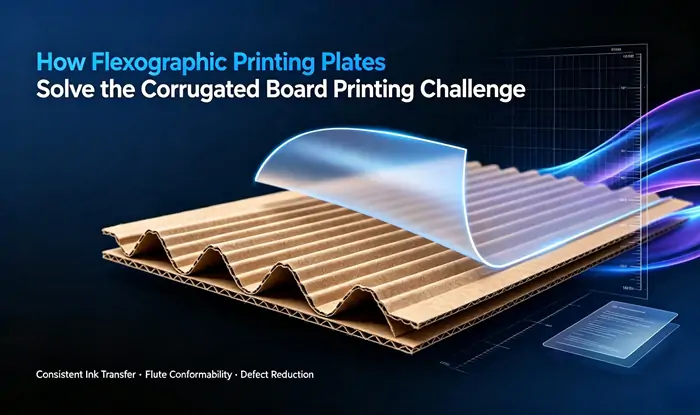
Corrugated board consists of a fluted medium sandwiched between two linerboards. The flutes create a wavy structure that gives the board its strength and cushioning properties—but this same structure creates an uneven printing surface.
When printing on corrugated board, the printing plate must contact both the peaks (flute tips) and valleys (flute valleys) of the corrugated medium. A rigid plate cannot conform to these height differences, resulting in:
Corrugated board also varies in thickness, surface smoothness, and absorbency depending on the grade and manufacturer. These variations add another layer of complexity to the printing process.
Flexographic printing plates are made from photopolymer materials that are soft and resilient. This flexibility is the key to overcoming the uneven surface of corrugated board.
Photopolymer plates compress against the substrate during printing. When the plate contacts the corrugated board, it conforms to the flute peaks and valleys, delivering consistent ink coverage across the entire print area.
Unlike rigid plates that cannot adapt to surface height differences, photopolymer plates act as a cushion that bridges the gaps between flutes. This ensures that ink reaches both the high points and low points of the board surface.
The hardness of a flexographic plate—measured on the Shore A scale—determines how well it conforms to the substrate.
| Plate Hardness | Best Application | Why |
|---|---|---|
| Softer (25-40 Shore A) | Corrugated board, rough substrates | Better conforms to uneven surfaces |
| Medium (40-50 Shore A) | Paper, folding cartons | Balance between conformability and dot stability |
| Harder (50+ Shore A) | Films, smooth substrates | Sharper dots, less dot gain |
For corrugated applications, softer plates are generally preferred. The SF-DGS Digital Versatile Flexo Plate, for example, is described as "softer and less rigid," making it ideal for corrugated board surfaces and reducing washboard effects. Similarly, the SF-L Digital Flexo Plates are designed specifically to meet all direct printing corrugated board requirements.
Modern digital flexo plates require minimum impression settings, which means less pressure is needed to achieve good ink transfer. Lower impression pressure reduces:
When selecting flexographic printing plates for corrugated applications, pay attention to these technical specifications:
| Characteristic | What to Look For | Why It Matters |
|---|---|---|
| Hardness (Shore A) | 29-49 for corrugated | Softer plates conform better to uneven surfaces |
| Thickness | 2.54mm - 7.00mm for corrugated | Thicker plates provide more cushioning |
| Tonal range | 3% - 95% | Wider range means better highlight and shadow detail |
| Minimum dot | 0.25mm - 0.75mm | Smaller dots mean finer detail reproduction |
| Screen ruling | 60-100 LPI for corrugated | Lower LPI suits the rougher corrugated surface |
For more detailed specifications, review the SF-L Digital Flexo Plates product page.
Within the flexographic plate category, buyers also face a choice between digital and analog plates.
| Factor | Analog Flexo Plates | Digital Flexo Plates |
|---|---|---|
| Plate-making | Film-based | Direct digital imaging |
| Registration accuracy | Good—but film shrinkage can introduce errors | Excellent—digital eliminates film variability |
| Highlight dots | Limited retention | Superior retention |
| Workflow speed | Slower—multiple film steps | Faster—direct-to-plate |
| Environmental impact | Film waste | No film required |
For corrugated applications requiring fine detail and fast turnaround, digital flexo plates offer significant advantages. The SF-DGS Digital Versatile Flexo Plate, for instance, provides "superior printing quality with sharper images, more open intermediate depths, finer highlight dots and less dot gain".
| Defect | Cause | How Flexo Plates Help |
|---|---|---|
| Washboard effect | Rigid plate cannot conform to flute pattern | Softer plates conform to flutes, reducing streaking |
| Pinholing | Incomplete ink transfer in solid areas | Better conformability ensures full contact |
| Dot gain | Excessive printing pressure | Minimum impression settings reduce dot gain |
| Plate edge lift | Poor mounting or contamination | Proper plate preparation and cleaning prevent lift |
| Misregistration | Plate movement or imprecise mounting | Digital plates offer better registration accuracy |
Use this checklist when evaluating flexographic printing plates for corrugated applications:
For personalized guidance based on your specific corrugated board types and production requirements, discuss your material and production requirements with the technical team.
Offset plates are rigid and cannot conform to the uneven surface of corrugated board. They require perfectly flat substrates to achieve consistent ink transfer. On corrugated board, offset plates would only contact the flute peaks, leaving the valleys unprinted.
The washboard effect refers to visible streaks or bands that follow the flute pattern of the corrugated board. It occurs when the printing plate cannot conform to the height differences between flute peaks and valleys, resulting in uneven ink coverage.
For corrugated board, softer plates (29-49 Shore A) are generally recommended. Softer plates conform better to the uneven surface, reducing washboard effects and improving solids coverage. The specific hardness depends on the board grade and flute type.
SF-L Digital Flexo Plates are designed specifically for direct printing on corrugated board, with thicknesses ranging from 2.54mm to 7.00mm. SF-DGS Digital Versatile Flexo Plate is softer and less rigid, making it ideal for corrugated board surfaces and reducing washboard effects. Both are digital plates that offer superior highlight dot retention.
Lifespan depends on substrate abrasiveness, press conditions, and maintenance practices. With proper care, flexographic plates can be reused for millions of impressions. Softer plates used on rough corrugated board may wear faster than harder plates used on smooth substrates.
Not always. Different board grades have different surface characteristics. Heavier boards with deeper flutes may require thicker or softer plates. It is recommended to test plates on the actual substrate before committing to a full production run.
Printing on corrugated board presents unique challenges due to the uneven, fluted surface. Flexographic printing plates—particularly digital photopolymer plates—are specifically designed to overcome these obstacles. Their soft, resilient material conforms to the flute peaks and valleys, delivering consistent ink transfer and reducing common defects like the washboard effect.
When selecting flexo plates for corrugated applications, pay attention to plate hardness, thickness, and tonal range. Softer plates in the 29-49 Shore A range are generally preferred for corrugated board. Digital plates offer superior highlight dot retention and faster workflow, making them the preferred choice for packaging work requiring fine detail and fast turnaround.
If you are planning a corrugated packaging project or looking to improve your current corrugated printing quality, review the available flexible printing plate configurations and discuss your specific substrate and production requirements with the supplier.
For a broader view of how flexo plates integrate into packaging workflows, explore the packaging printing solutions available for different applications.
GET A QUOTE