Get A Quote
Aug 25,2026
Packaging printers considering flexographic printing face an important decision early in the plate selection process: digital or analog? Both technologies use photopolymer materials to create relief printing plates, but the plate-making process, print quality, and workflow efficiency differ significantly. Digital flexo plates are imaged directly from digital files without film, while analog flexo plates require a film negative as an intermediate step. This article compares the two plate types across key decision factors and provides a practical framework for choosing the right option for your packaging production.
To explore the available options, review the flexible printing plate configurations designed for different packaging applications.
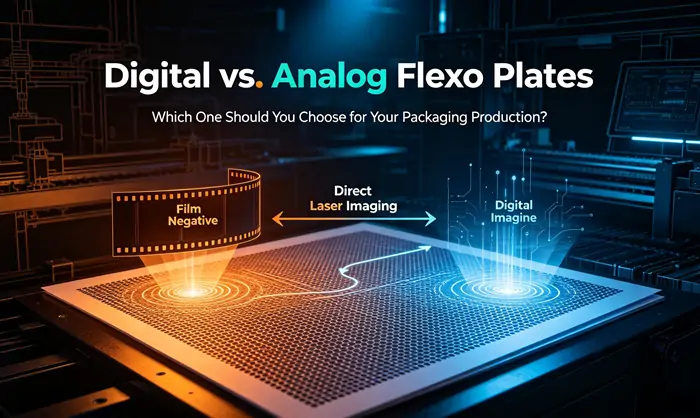
Analog flexo plates (also called conventional flexo plates) are made using a film-based workflow. A film negative is produced from the digital design file, then placed in contact with the photopolymer plate for UV exposure. The plate is then washed out, dried, and post-exposed. This process has been the industry standard for decades and remains a cost-effective option for many applications.
Digital flexo plates are imaged directly from digital files using a laser imaging system. No film is involved—the digital file is sent directly to an imaging device that exposes the plate with a laser. This eliminates film-related errors and streamlines the entire prepress workflow. Digital plates are increasingly the standard for packaging work requiring fine detail and fast turnaround.
| Factor | Analog Flexo Plates | Digital Flexo Plates |
|---|---|---|
| Plate-making process | Film-based (requires film output) | Direct digital imaging (no film) |
| Film requirement | Yes—film negative needed | No—film eliminated |
| Registration accuracy | Good—but film shrinkage can introduce errors | Excellent—digital eliminates film variability |
| Highlight dot retention | Limited—fine dots may wash out | Superior—better retention of fine details |
| Prepress workflow | Slower—multiple film steps | Faster—direct-to-plate |
| Environmental impact | Film waste and chemistry | No film required, more environmentally friendly |
| Cost | Lower upfront equipment cost | Higher upfront, better long-term value |
| Image quality | Good for simpler jobs | Superior for high-quality graphics |
Each film step introduces potential for error—film shrinkage, dust, or misalignment can all affect final plate quality.
The digital workflow eliminates the film step entirely, reducing image degradation and preserving finer highlight dots.
The most significant advantage of digital flexo plates is superior print quality, particularly in highlight areas.
| Quality Factor | Analog Flexo Plates | Digital Flexo Plates |
|---|---|---|
| Highlight dot retention | Limited | Superior—finer highlight dots |
| Dot gain | Higher | Lower—less dot gain |
| Tonal range | Good | Wider—larger range of tonal values |
| Image sharpness | Good | Sharper images |
| Intermediate depths | Limited | More open intermediate depths |
| Contrast | Standard | Improved contrast |
Digital plates produce flat top dots when adequate process equipment is used, which further improves print consistency and reduces dot gain. This is particularly important for packaging with fine text, barcodes, and detailed graphics.
| Cost Factor | Analog Flexo Plates | Digital Flexo Plates |
|---|---|---|
| Equipment investment | Lower (film output devices are less expensive) | Higher (laser imaging systems cost more) |
| Per-plate cost | Lower for simple jobs | Higher upfront, better value for complex work |
| Film cost | Ongoing film and chemistry costs | No film required |
| Labor | More steps, more handling | Fewer steps, less handling |
| Waste disposal | Film waste and chemistry disposal | No film waste |
| Total cost per job | Higher for complex, short-run work | Lower for complex, short-run work |
While analog plates may appear cheaper on a per-plate basis, digital plates often deliver lower total cost per job when factoring in faster setup, less waste, and reduced film costs.
Analog flexo plates remain a practical choice in specific scenarios:
1. Simple graphics with low detail requirements. If your packaging uses mostly solid colors, large text, or simple line art, analog plates can deliver acceptable quality at lower cost.
2. Limited capital budget. If you cannot justify the investment in a digital imaging system, analog plates offer a lower barrier to entry.
3. Existing analog infrastructure. If your prepress department is already equipped with film output and exposure equipment, switching to digital would require significant capital investment.
4. Very long runs on simple substrates. For extremely long runs of simple packaging, the per-plate cost advantage of analog plates may outweigh the quality benefits of digital.
Digital flexo plates are increasingly the preferred choice for modern packaging production. Here are the scenarios where they excel:
If your packaging includes fine text, barcodes, detailed illustrations, or photographic images, digital plates are essential. They preserve finer highlight dots and produce sharper images with more open intermediate depths and improved contrast.
For applications like cosmetic boxes, pharmaceutical packaging, and premium food packaging, digital plates deliver the print quality that brand owners expect.
Packaging runs are getting shorter. Brand owners want regional variations, seasonal promotions, and rapid design updates. Digital plates eliminate the film step, compressing the prepress workflow and getting plates to press faster.
For printers juggling multiple short-run jobs per shift, this speed translates directly to more sellable press hours.
Digital plates eliminate film and chemistry from the plate-making process, reducing waste and environmental impact. For printers with sustainability commitments or regulatory requirements, digital plates offer a cleaner workflow.
STRONG offers both digital and analog options. The SF-DGS Digital Versatile Flexo Plate, for example, is a digital sheet-fed photopolymer that provides "superior printing quality with sharper images, more open intermediate depths, finer highlight dots and less dot gain". It is also described as "cost effective and more environmentally friendly in processing, as no film is required".
Digital plates eliminate film shrinkage errors, providing more consistent registration accuracy. For multi-color packaging work requiring tight registration, this consistency is critical.
Use this checklist to evaluate your specific requirements:
For personalized guidance based on your specific graphics requirements and production volume, discuss your material and production requirements with the technical team.
Misconception 1: "Digital plates are always more expensive."
Reality: Digital plates have higher upfront equipment costs but often deliver lower total cost per job when factoring in faster setup, less waste, and no film costs.
Misconception 2: "Analog plates can't produce good quality."
Reality: Analog plates can produce acceptable quality for simple graphics. The quality gap becomes significant only when fine screens, small text, or detailed images are required.
Misconception 3: "Switching to digital means replacing all your equipment."
Reality: Many printers phase in digital plates gradually, starting with high-quality work while continuing analog for simpler jobs. Both plate types can coexist in the same operation.
The main difference is the plate-making process. Digital flexo plates are imaged directly from digital files using a laser, eliminating the film step entirely. Analog flexo plates require a film negative as an intermediate step. This difference affects print quality, workflow speed, and cost.
Digital flexo plates generally produce superior print quality, particularly in highlight areas. They preserve finer highlight dots, produce sharper images, and have less dot gain. Analog plates can produce acceptable quality for simpler graphics.
Digital plates have higher upfront equipment costs but often deliver lower total cost per job when factoring in faster setup, less waste, and no film costs. The per-plate cost of digital plates is typically higher, but the total cost per job may be lower for complex, short-run work.
Yes. Many printers use both plate types, reserving digital plates for high-quality work and analog plates for simpler jobs. This allows printers to balance quality requirements with cost considerations.
Digital plates eliminate film and chemistry from the plate-making process, reducing waste and environmental impact. Analog plates require film and processing chemistry, which generate waste and disposal costs.
Digital plates are worth the investment if you print high-quality graphics with fine details, run short to medium runs with frequent changeovers, or have sustainability requirements. For simple graphics on long runs, analog plates may be more cost-effective.
The choice between digital and analog flexo plates is not about which is "better" in absolute terms—it is about which fits your specific production requirements. Analog flexo plates remain a practical, cost-effective option for simple graphics and operations with limited capital budgets. Digital flexo plates offer superior print quality, faster workflow, and environmental benefits that make them the preferred choice for modern packaging production.
For most packaging operations—particularly those handling high-quality graphics, short runs, or frequent design changes—digital flexo plates provide a compelling combination of print quality, speed, and sustainability. The elimination of film and chemistry reduces waste and simplifies the prepress workflow, while superior highlight dot retention delivers the print quality that today's packaging market demands.
If you are evaluating plate options for a new packaging project or considering a transition from analog to digital, review the available flexible printing plate configurations and discuss your specific graphics and production requirements with the supplier. For more detailed technical specifications, explore the SF-DGS Digital Versatile Flexo Plate and SF-GT Analog Photopolymer Sheet Plates product pages.
GET A QUOTE